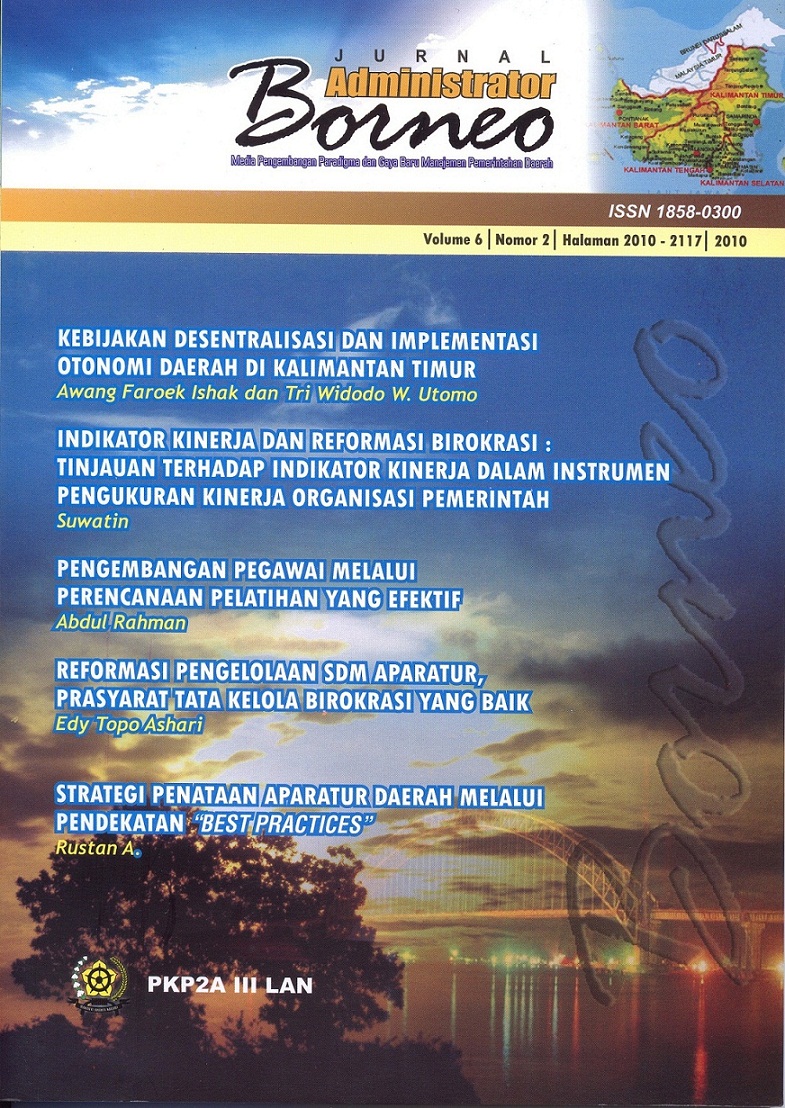
KEBIJAKAN DESENTRALISASI DAN IMPLEMENTASI OTONOMI DAERAH DI KALIMANTAN TIMUR
DOI:
https://doi.org/10.24258/jba.v6i2.57Abstract
Decentralization is a perfect concept but it doesn’t always demonstrate its superiority in the implementation stage. Approximately 80% new autonomous regions in Indonesia are considered to be failed in implementing decentralization values. In order to achieve the expected outcomes, decentralization should be accompanied by appropriate preconditions such as careful planning, effective implementation, and sufficient capacity both in individual, institutional, and system level. In the context of East Kalimantan Province, decentralization is perceived as an opportunity to accelerate local development through broader authorities and wider financial resources. In other words, East Kalimantan Provincial Government is visioning decentralization as an instrument to run governance reform and, at the same time, as a precondition to better development processes. Besides, the implementation of decentralization in East Kalimantan Province is directed to produce a synergistic win-win relationship with the central government, not a kind of trade-off or zero-sum relationship. In that sense, East Kalimantan Provincial Government has formulated priority agendas on local development issues. These priorities would be combined with pillars of bureaucratic reform as key leverage and indicators to measure the progress of local development in the wide-decentralization era.Keywords: Desentralisasi, Otonomi Daerah, Kalimantan Timur
Downloads
Download data is not yet available.
Downloads
How to Cite
Tri Widodo W. Utomo, A. F. I. dan. (2014). KEBIJAKAN DESENTRALISASI DAN IMPLEMENTASI OTONOMI DAERAH DI KALIMANTAN TIMUR. Jurnal Borneo Administrator, 6(2). https://doi.org/10.24258/jba.v6i2.57
Issue
Section
Articles
License
Copyright (c) 2014 Author(s)

This work is licensed under a Creative Commons Attribution-NonCommercial-ShareAlike 4.0 International License.
Policy for Journals That Offer Open Access
Authors who publish with this journal agree to the following terms:
- Authors retain copyright and grant the journal right of first publication with the work simultaneously licensed under a Creative Commons Attribution-NonCommercial-ShareAlike 4.0 International License that allows others to share the work with an acknowledgement of the work's authorship and initial publication in this journal.
- Authors are able to enter into separate, additional contractual arrangements for the non-exclusive distribution of the journal's published version of the work (e.g., post it to an institutional repository or publish it in a book), with an acknowledgement of its initial publication in this journal.
- Authors are permitted and encouraged to post their work online (e.g., in institutional repositories or on their website) prior to and during the submission process, as it can lead to productive exchanges, as well as earlier and greater citation of published work (See The Effect of Open Access).