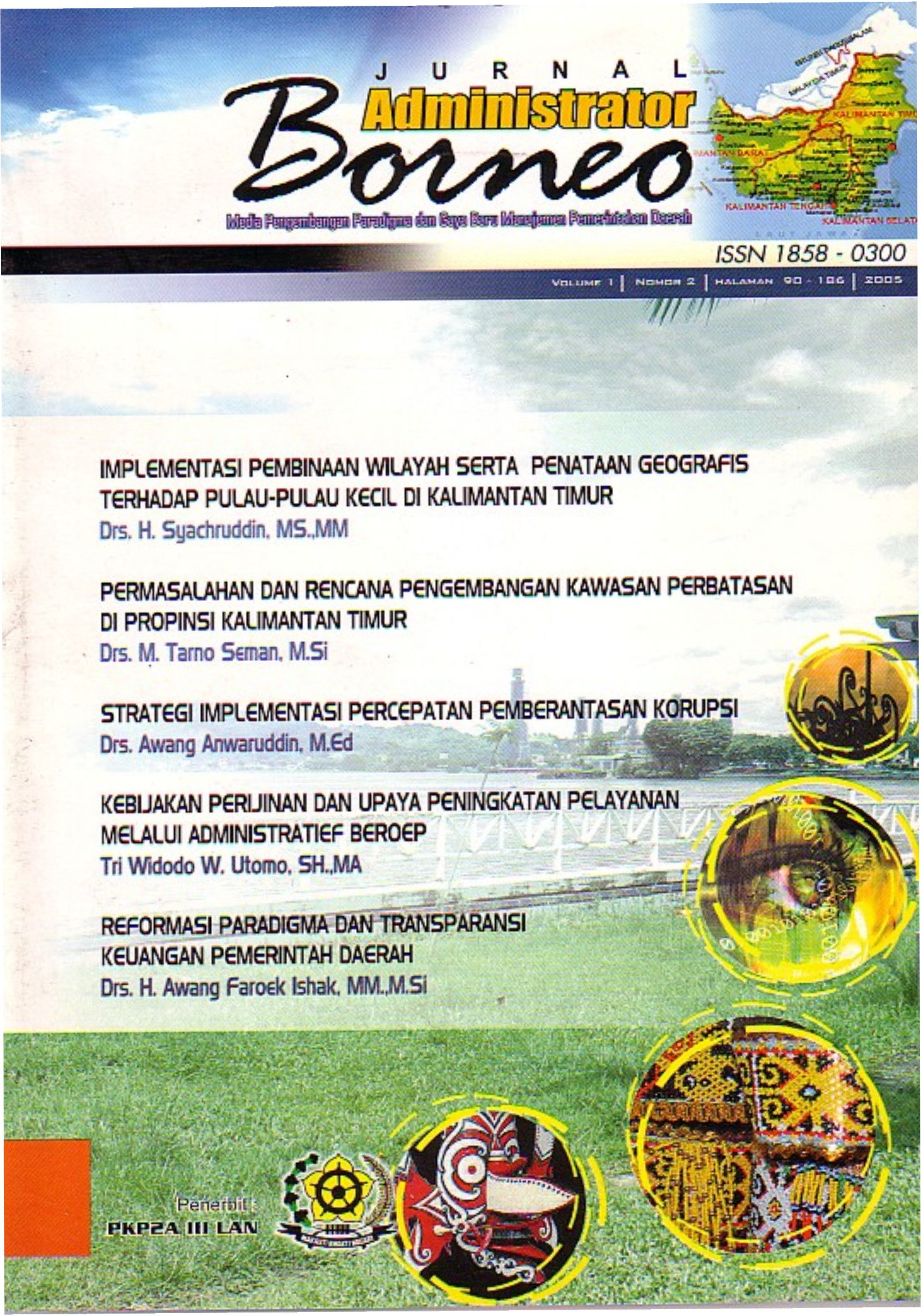
STRATEGI IMPLEMENTASI PERCEPATAN PEMBERANTASAN KORUPSI
DOI:
https://doi.org/10.24258/jba.v1i2.6Abstract
Since the last two months, two extraordinary issues in home country have shaken the political world. Alas, both issues concerns the most-hated moral patoplogy: corruption! The first issue relates to the case of bribery by an eminent member of General Election Comission (KPU), and the second is the case of corruption indication by the Chief Director of Bank Mandiri. The new lesson of both cases is hopefully that our government has entered a new era of corruption abolition: enforcing law and order fairly to any citizens without considering their status. A condition that hardly happened during the previous governments! Such high spirit of abolishing corruption seems triggered by the President Yudoyono’s commitment to make 2005 as the Year of Corruption Abolition. The commitment was then strengthened by the launching of several steps on abolsihing corruption last month, following the Presidential Instruction Number No. 5/2004 on the Alleviation of Corruption Abolition.Downloads
Download data is not yet available.
Downloads
Published
2014-01-22
How to Cite
Awang Anwaruddin, D. (2014). STRATEGI IMPLEMENTASI PERCEPATAN PEMBERANTASAN KORUPSI. Jurnal Borneo Administrator, 1(2). https://doi.org/10.24258/jba.v1i2.6
Issue
Section
Articles
License
Copyright (c) 2014 Author(s)

This work is licensed under a Creative Commons Attribution-NonCommercial-ShareAlike 4.0 International License.
Policy for Journals That Offer Open Access
Authors who publish with this journal agree to the following terms:
- Authors retain copyright and grant the journal right of first publication with the work simultaneously licensed under a Creative Commons Attribution-NonCommercial-ShareAlike 4.0 International License that allows others to share the work with an acknowledgement of the work's authorship and initial publication in this journal.
- Authors are able to enter into separate, additional contractual arrangements for the non-exclusive distribution of the journal's published version of the work (e.g., post it to an institutional repository or publish it in a book), with an acknowledgement of its initial publication in this journal.
- Authors are permitted and encouraged to post their work online (e.g., in institutional repositories or on their website) prior to and during the submission process, as it can lead to productive exchanges, as well as earlier and greater citation of published work (See The Effect of Open Access).