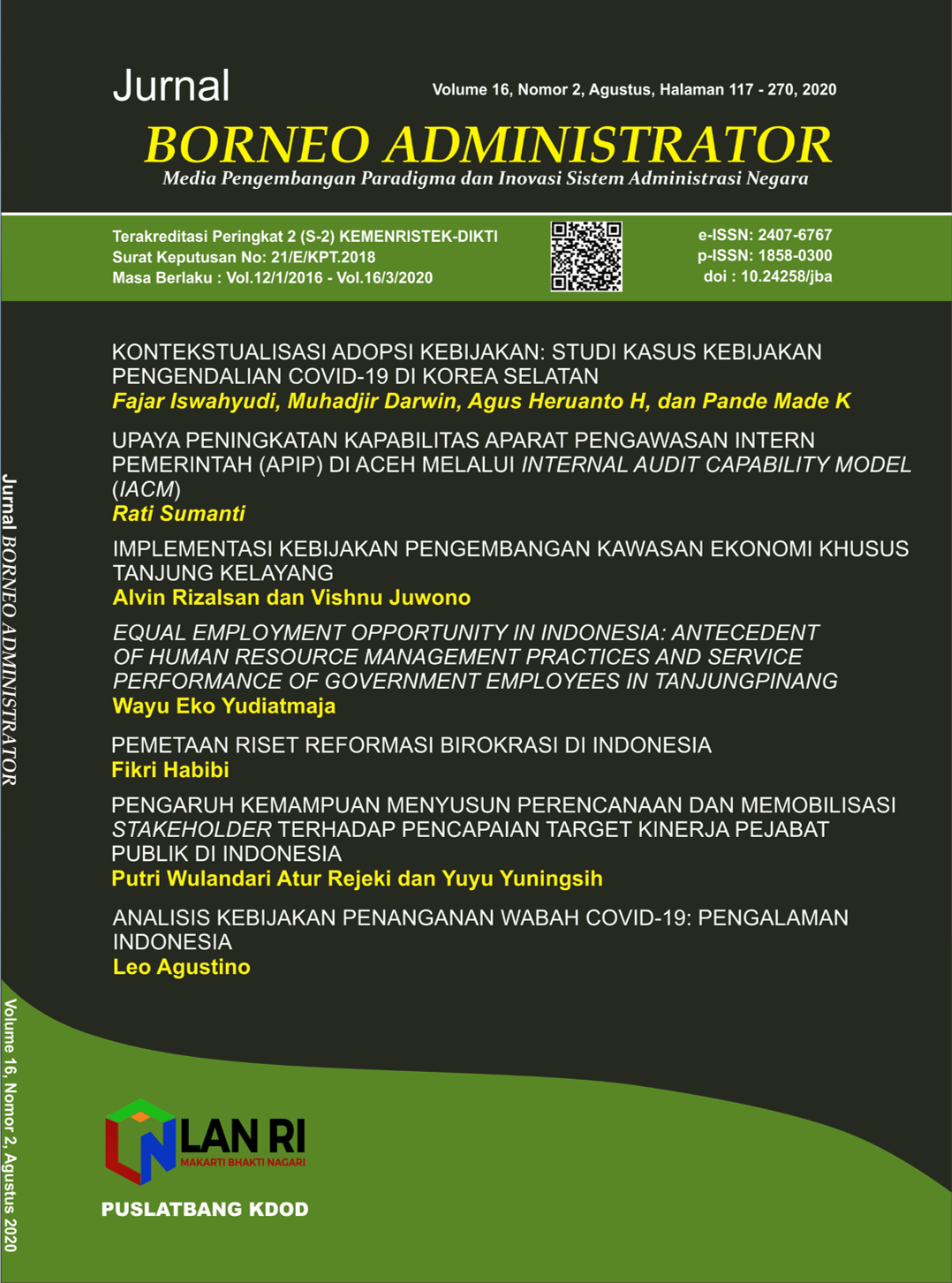
Upaya Peningkatan Kapabilitas Aparat Pengawasan Intern Pemerintah (APIP) di Aceh Melalui Internal Audit Capability Model (IACM)
Improvement Efforts of Internal Government Supervisory Apparatus (APIP) in Aceh Through Internal Audit Capability Model (IACM)
DOI:
https://doi.org/10.24258/jba.v16i2.654Abstract
Internal Government Supervisory Apparatus (APIP) is an actor who conducts internal audit. The top level of capability of APIP shows that APIP is getting better in carrying out its role as an internal supervisor. However, not all APIP in Aceh have a good level of capability. Therefore, the Aceh BPKP Representative as the APIP supervisor agency seeks to increase the level of APIP capabilities through the Internal Audit Capability Model (IACM). This study aims to describe how the implementation of IACM in the region is proven to increase the capability level of APIP. Using a qualitative approach with a case study method, interviews were conducted with officials in the Aceh BPKP who were considered being representative so they could provide accurate information on the problem under study. There are 6 elements capability of APIP comprising 24 key process areas to reach level 3. Representatives of BPKP Aceh have improved capabilities of the six elements capability of APIP. Coaching conducted comprehensively has fulfilled 24 key process areas required in IACM including coaching and consulting activities. The findings in this study showed that of the 24 APIP in Aceh, 16 APIP or 67% have increased capability levels. This means that implementing IACM conducted by the Aceh BPKP Representative shows a positive impact on improving the capabilities of APIP. So this research contributes to the practice where other local governments can adopt the efforts and improvements that need to be made according to the six elements of APIP capabilities.
Keywords: Internal Audit, Internal Government Supervisory Apparatus (APIP), Capabilityof APIP, Finance and Development Supervisory Agency (BPKP)
Abstrak
Aparat Pengawasan Intern Pemerintah (APIP) adalah aktor yang melakukan pengawasan intern. Tingginya level kapabilitas APIP menunjukkan semakin baik pula APIP dalam menjalankan perannya sebagai pengawas intern. Namun demikian, belum semua APIP di Aceh memiliki level kapabilitas yang baik. Oleh karenanya, Perwakilan BPKP Aceh selaku instansi pembina APIP berupaya melakukan peningkatan level kapabilitas APIP melalui Internal Audit Capability Model (IACM). Penelitian ini bertujuan untuk melihat gambaran bagaimana penerapan IACM di daerah apakah terbukti mampu meningkatkan level kapabilitas APIP. Menggunakan pendekatan kualitatif dengan metode studi kasus, dilakukan wawancara kepada Pejabat di Perwakilan BPKP Aceh yang dianggap representatif sehingga dapat memberikan informasi yang akurat terhadap masalah yang diteliti. Ada 6 elemen kapabilitas APIP yang terdiri atas 24 area proses kunci untuk mencapai level 3. Perwakilan BPKP Aceh telah meningkatkan kapabilitas pada enam elemen kapabilitas APIP tersebut. Pembinaan yang dilakukan secara komprehensif telah memenuhi 24 area proses kunci yang dipersyaratkan dalam IACM, yang meliputi kegiatan pembinaan dan konsultasi. Temuan dalam penelitian ini menunjukkan bahwa dari 24 APIP di wilayah Aceh, 16 APIP Pemerintah Daerah atau 67% mengalami peningkatan level kapabilitas. Hal ini berarti penerapan IACM yang dilakukan oleh Perwakilan BPKP Aceh menunjukkan dampak positif bagi peningkatan kapabilitas APIP, sehingga penelitian ini memberikan kontribusi praktik sehingga pemerintah daerah lainnya dapat mengadopsi upaya-upaya serta perbaikan yang perlu dilakukan sesuai enam elemen kapabilitas APIP.
Kata kunci: Pengawasan Internal, Aparat Pengawasan Intern Pemerintah (APIP), Kapabilitas APIP, Badan Pengawasan Keuangan dan Pembangunan (BPKP)
Downloads
Downloads
Published
How to Cite
Issue
Section
License
Copyright (c) 2020 Author(s)

This work is licensed under a Creative Commons Attribution-NonCommercial-ShareAlike 4.0 International License.
Policy for Journals That Offer Open Access
Authors who publish with this journal agree to the following terms:
- Authors retain copyright and grant the journal right of first publication with the work simultaneously licensed under a Creative Commons Attribution-NonCommercial-ShareAlike 4.0 International License that allows others to share the work with an acknowledgement of the work's authorship and initial publication in this journal.
- Authors are able to enter into separate, additional contractual arrangements for the non-exclusive distribution of the journal's published version of the work (e.g., post it to an institutional repository or publish it in a book), with an acknowledgement of its initial publication in this journal.
- Authors are permitted and encouraged to post their work online (e.g., in institutional repositories or on their website) prior to and during the submission process, as it can lead to productive exchanges, as well as earlier and greater citation of published work (See The Effect of Open Access).