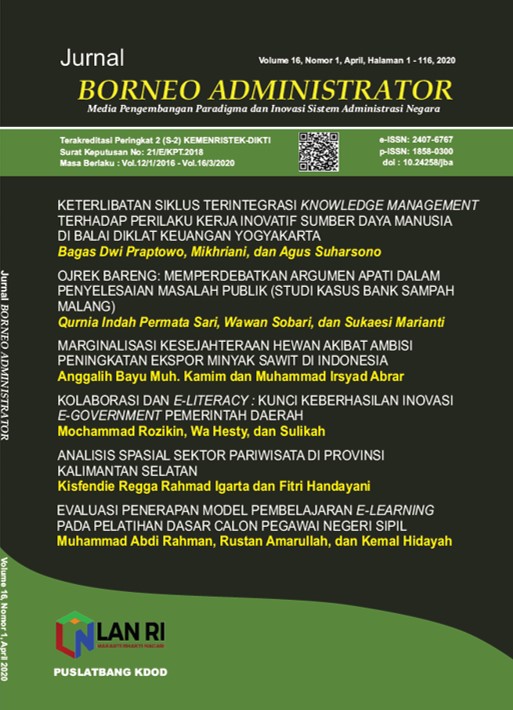
Evaluasi Penerapan Model Pembelajaran E-Learning pada Pelatihan Dasar Calon Pegawai Negeri Sipil
Evaluation of E-Learning Models Implementation in Basic Training of Prospective Civil Servants
DOI:
https://doi.org/10.24258/jba.v16i1.656Abstract
Technological developments in the industrial 4.0 revolution era have driven changes in the ways of work and use of resources in the digital era. Likewise, training mechanism, from conventional learning patterns to the network learning (online). Training and development in the government environment has discussed aggressively the concept of e-learning to provide new learning alternatives for trainees. This research used a qualitative-descriptive tried to evaluate the effectiveness of e-learning model in the Basic Training of Prospective Civil Servants. The results showed that the implementation of e-learning was effective enough to be used to increase participants' understanding of the training subjects. The quality and sustainability of the use of e-learning need to be improved so that it can effectively complement classical learning (blended learning). Mapping of efforts to optimize e-learning has also been identified starting from revamping the e-learning system/ application, learning facilitators, implementation time, and the need to adapt conventional learning elements.
Keywords: E-learning, Training, Basic Training, Prospective Civil Servants (CPNS)
Abstrak
Kemajuan teknologi di era revolusi industri 4.0 telah mendorong terjadinya perubahan-perubahan cara kerja dan penggunaan sumber daya ke arah digital. Begitu juga mekanisme pelatihan, dari pola pembelajaran konvensional secara klasikal ke pembelajaran dalam jaringan (daring). Pelatihan dan pengembangan di lingkungan pemerintahan sudah mulai gencar mengadopsi konsep pembelajaran e-learning guna memberikan alternatif pembelajaran baru bagi peserta pelatihan. Penelitian ini secara kualitatif-deskriptif mencoba mengevaluasi efektivitas penerapan model pembelajaran secara e-learning pada lingkup Pelatihan Dasar Calon Pegawai Negeri Sipil. Hasil studi ini mengindikasikan bahwa implementasi e-learning cukup efektif digunakan untuk meningkatkan pemahaman peserta terhadap mata pelatihan. Kualitas dan keberlangsungan penggunaan e-learning perlu ditingkatkan sehingga dapat secara efektif melengkapi pembelajaran klasikal (blended learning). Pemetaan terhadap upaya mengoptimalkan e-learning juga telah diidentifikasi mulai dari pembenahan sistem/aplikasi e-learning, fasilitator pembelajaran, waktu pelaksanaan, dan perlunya adaptasi unsur-unsur pembelajaran konvensional.
Kata kunci: E-learning, Pelatihan, Pelatihan Dasar, CPNS
Downloads
Downloads
Published
How to Cite
Issue
Section
License
Copyright (c) 2020 Author(s)

This work is licensed under a Creative Commons Attribution-NonCommercial-ShareAlike 4.0 International License.
Policy for Journals That Offer Open Access
Authors who publish with this journal agree to the following terms:
- Authors retain copyright and grant the journal right of first publication with the work simultaneously licensed under a Creative Commons Attribution-NonCommercial-ShareAlike 4.0 International License that allows others to share the work with an acknowledgement of the work's authorship and initial publication in this journal.
- Authors are able to enter into separate, additional contractual arrangements for the non-exclusive distribution of the journal's published version of the work (e.g., post it to an institutional repository or publish it in a book), with an acknowledgement of its initial publication in this journal.
- Authors are permitted and encouraged to post their work online (e.g., in institutional repositories or on their website) prior to and during the submission process, as it can lead to productive exchanges, as well as earlier and greater citation of published work (See The Effect of Open Access).