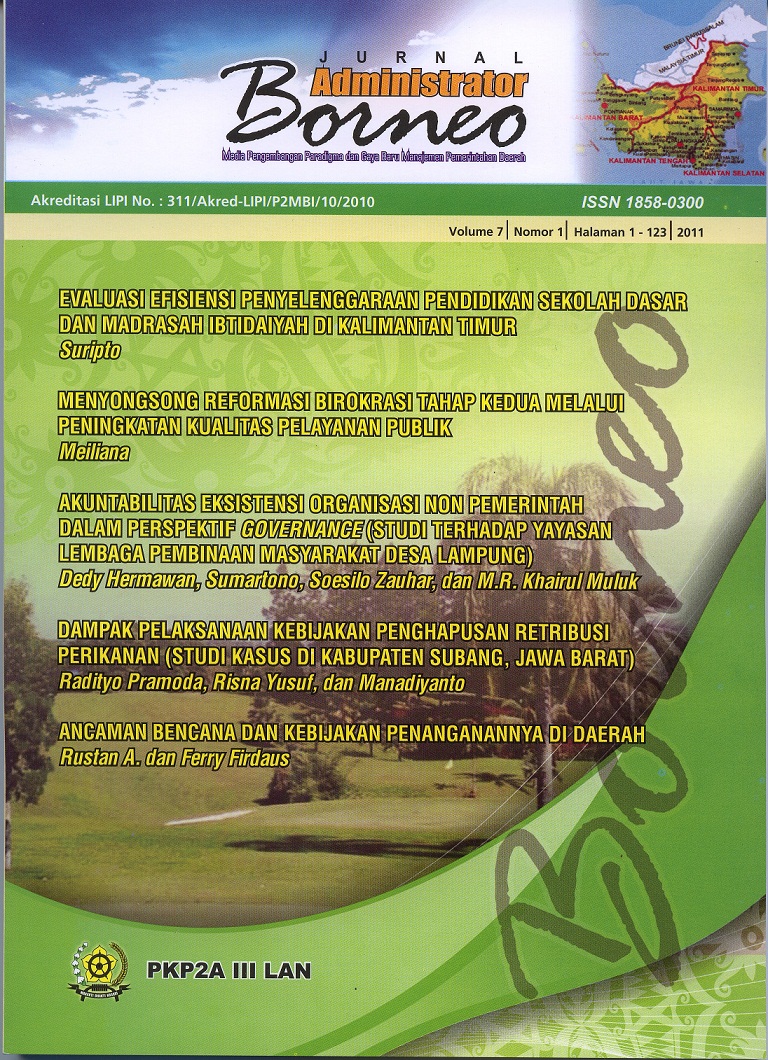
EVALUASI EFISIENSI PENYELENGGARAAN PENDIDIKAN SEKOLAH DASAR DAN MADRASAH IBTIDAIYAH DI KALIMANTAN TIMUR
DOI:
https://doi.org/10.24258/jba.v7i1.67Abstract
Education is the right of every citizen. East Kalimantan Province has a 12-year free education program. Gross enrollment ratios Primary School level in 2009 reached 112.30 percent and high school level GER ranked fourth nationally. On the other hand, East Kalimantan Province also has limitations in education facilities and infrastructure. Some barriers are factors such as land area, population distribution is uneven and limited transportation infrastructure. With these achievements and constraints, it is necessary to evaluate the education in East Kalimantan province. Furthermore, in conducting the evaluation used data analysis tools Envelopment Analysis (DEA) model of Banker Charnes and Cooper (BCC) with output orientation. Results Analysis showed that District/Municipality covers a relatively efficient Paser District, Berau District, Manilau District, Balikpapan Municipality, Samarinda Municipality Penajam Paser District, Tarakan Municipality, East Kutai District, West Kutai District, and Bontang Municipality. While the relatively inefficient covering Kutai Kartanegara District, Bulungan District, Nunukan District, District/Municipality that became a reference in the increased efficiency is Paser District, Berau District, Samarinda and Bontang Municipalities. Furthermore, the Municipality of Samarinda is the most efficient evaluation unit and at most be a reference to increased efficiency.Keywords : evaluation, education, eficiency, and East Kalimantan.
Pendidikan adalah hak setiap warga Negara. Provinsi Kalimantan Timur (Kaltim) telah memiliki program pendidikan gratis 12 tahun. Angka Partisipasi Kasar (AKP) jenjang Sekolah Dasar (SD) pada tahun 2009 mencapai 112,30 persen dan APK jenjang Sekolah Menengah Atas (SMA) Kaltim menempati urutan ke-empat nasional. Disisi lain, Provinsi Kaltim juga menghadapi kendala keterbatas dalam sarana dan prasarana pendidikan. Kendala tersebut disebabkan beberapa faktor antara lain luasnya wilayah, penyebaran penduduk yang tidak merata dan terbatasnya prasarana trasportasi. Dengan prestasi dan Kendala tersebut, maka perlu dilakukan evaluasi penyelenggaraan pendidikan di Provinsi Kaltim? Selanjuntya, dalam melakukan evaluasi digunakan alat analisis Data Envelopment Analysis (DEA) model Banker, Charnes, dan Cooper (BCC) dengan orientasi output. Hasil Analisis menunjukan bahwa kabupten/kota yang relatif efisien meliputi Kabupaten Paser, Kabupaten Berau, Kabupaten Manilau, Kota Balikpapan, Kota Samarinda, Kabupaten Kutai Barat, Kabupaten Kutai Timur, Kabupaten Penajam Paser Utara, Kota Tarakan. dan Kota Bontang. Sedangkan yang relatif belum efisien meliputi Kabupaten Kutai Kartanegara, Kabupaten Bulungan, Kabupaten Nunukan, Kabupten/kota yang menjadi referensi dalam peningkatan efisiensi adalah Kabupaten Paser, Kabupaten Berau, Kota Bontang dan Kota Samarinda. Selanjuntya, Kota Samarinda merupakan unit evaluasi yang paling efisien dan paling banyak menjadi referensi peningkatan efisiensi.
Kata kunci: evaluasi, pendidikan, efisien dan Kaltim
Downloads
Download data is not yet available.
Downloads
How to Cite
to, S. (2014). EVALUASI EFISIENSI PENYELENGGARAAN PENDIDIKAN SEKOLAH DASAR DAN MADRASAH IBTIDAIYAH DI KALIMANTAN TIMUR. Jurnal Borneo Administrator, 7(1). https://doi.org/10.24258/jba.v7i1.67
Issue
Section
Articles
License
Copyright (c) 2014 Author(s)

This work is licensed under a Creative Commons Attribution-NonCommercial-ShareAlike 4.0 International License.
Policy for Journals That Offer Open Access
Authors who publish with this journal agree to the following terms:
- Authors retain copyright and grant the journal right of first publication with the work simultaneously licensed under a Creative Commons Attribution-NonCommercial-ShareAlike 4.0 International License that allows others to share the work with an acknowledgement of the work's authorship and initial publication in this journal.
- Authors are able to enter into separate, additional contractual arrangements for the non-exclusive distribution of the journal's published version of the work (e.g., post it to an institutional repository or publish it in a book), with an acknowledgement of its initial publication in this journal.
- Authors are permitted and encouraged to post their work online (e.g., in institutional repositories or on their website) prior to and during the submission process, as it can lead to productive exchanges, as well as earlier and greater citation of published work (See The Effect of Open Access).