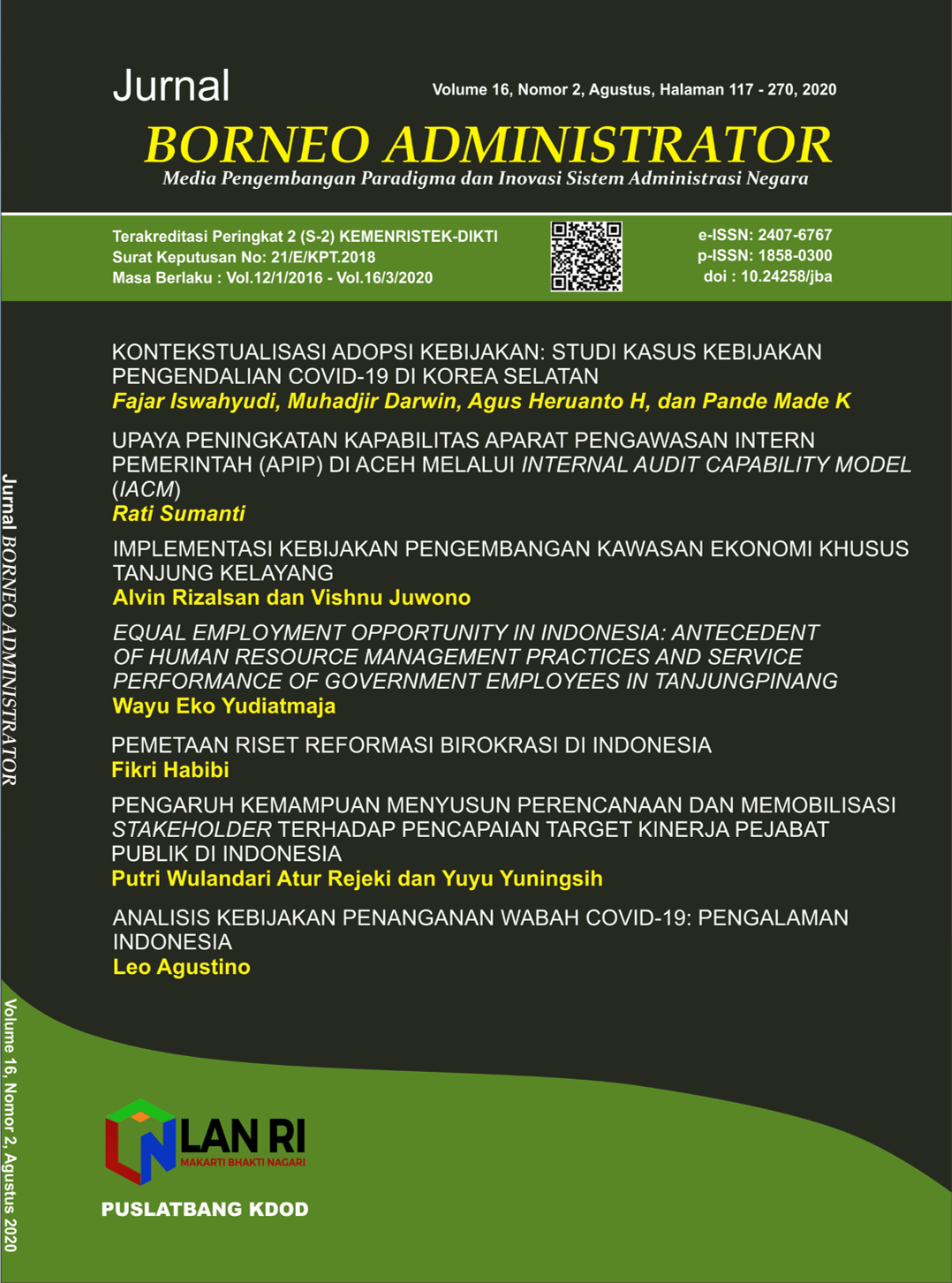
Kontekstualisasi Adopsi Kebijakan: Studi Kasus Kebijakan Pengendalian Covid-19 di Korea Selatan
Contextualization in Policy Adoption: Case Study of Covid-19 Control Policy in South Korea
DOI:
https://doi.org/10.24258/jba.v16i2.682Abstract
South Korea is one of the countries that has successfully controlled Covid-19. The successes obtained by implementing policies, namely: tests, tracking, treatment, and social distancing. This success invited other countries to adopt policies. Policy adoption needs to be done by considering the policy context through three perspectives, namely rationality, organizational, and political. This research will reveal the context of South Korean policy from each perspective. The research method used to discuss the topic is document analysis. From a rationality perspective, the South Korean Government's policy has potent correlation both theoretically and empirically in controlling Covid-19. From an organizational perspective, the determination of South Korean government policy is limited by the rules apply in the organization. From a political perspective, the determination of the policy of the South Korean Government is limited by political pressure on policy makers. This condition is the reason the South Korean Government tends chooses policies for conducting tests, tracking, maintaining, and social distancing over other policies to control Covid-19. Although other policies have a better ability to control Covid-19, those who wish to adopt the policy of the South Korean Government can seek and take advantage of other policy alternatives. Especially, not experiencing organizational and political boundaries as happened in South Korea.
Keywords: Covid-19, South Korea Government, Policy, Control
Abstrak
Korea Selatan menjadi salah satu negara yang berhasil mengendalikan Covid-19. Keberhasilan tersebut diperoleh dengan melaksanakan empat kebijakan, yaitu: pelaksanaan tes, penelusuran, perawatan, dan menjaga jarak fisik. Keberhasilan ini mengundang negara lain untuk melakukan adopsi kebijakan. Adopsi kebijakan perlu dilakukan dengan memperhatikan konteks kebijakan melalui tiga perspektif, yaitu rasionalitas, organisasional, dan politik. Penelitian ini akan mengungkap konteks kebijakan Korea Selatan tersebut. Metode penelitian yang digunakan untuk membahas permasalahan tersebut adalah analisis dokumen. Dari perspektif rasionalitas, kebijakan Pemerintah Korea Selatan tersebut memiliki korelasi yang kuat, baik secara teoritis maupun empiris dalam mengendalikan Covid-19. Dari perspektif organisasional, penentuan kebijakan pemerintah Korea Selatan dibatasi oleh aturan yang berlaku dalam organisasi. Dari perspektif politik, penentuan kebijakan Pemerintah Korea Selatan dibatasi oleh adanya tekanan politik kepada pembuat kebijakan. Kondisi tersebut menjadi alasan mengapa Pemerintah Korea Selatan cenderung memilih kebijakan untuk pelaksanaan tes, penelusuran, perawatan, dan menjaga jarak fisik dibandingkan kebijakan lain guna mengendalikan Covid-19. Walaupun kebijakan lain tersebut memiliki kemampuan yang lebih baik dalam mengendalikan Covid-19. Untuk itu bagi para pihak yang ingin mengadopsi kebijakan Pemerintah Korea Selatan dapat mencari dan memanfaatkan alternatif kebijakan lain. Khususnya ketika tidak mengalami batasan organisasional dan politik seperti yang terjadi di Korea Selatan.
Kata Kunci: Covid-19, Korea Selatan, Kebijakan, Pengendalian
Downloads
Downloads
Published
How to Cite
Issue
Section
License
Copyright (c) 2020 Author(s)

This work is licensed under a Creative Commons Attribution-NonCommercial-ShareAlike 4.0 International License.
Policy for Journals That Offer Open Access
Authors who publish with this journal agree to the following terms:
- Authors retain copyright and grant the journal right of first publication with the work simultaneously licensed under a Creative Commons Attribution-NonCommercial-ShareAlike 4.0 International License that allows others to share the work with an acknowledgement of the work's authorship and initial publication in this journal.
- Authors are able to enter into separate, additional contractual arrangements for the non-exclusive distribution of the journal's published version of the work (e.g., post it to an institutional repository or publish it in a book), with an acknowledgement of its initial publication in this journal.
- Authors are permitted and encouraged to post their work online (e.g., in institutional repositories or on their website) prior to and during the submission process, as it can lead to productive exchanges, as well as earlier and greater citation of published work (See The Effect of Open Access).