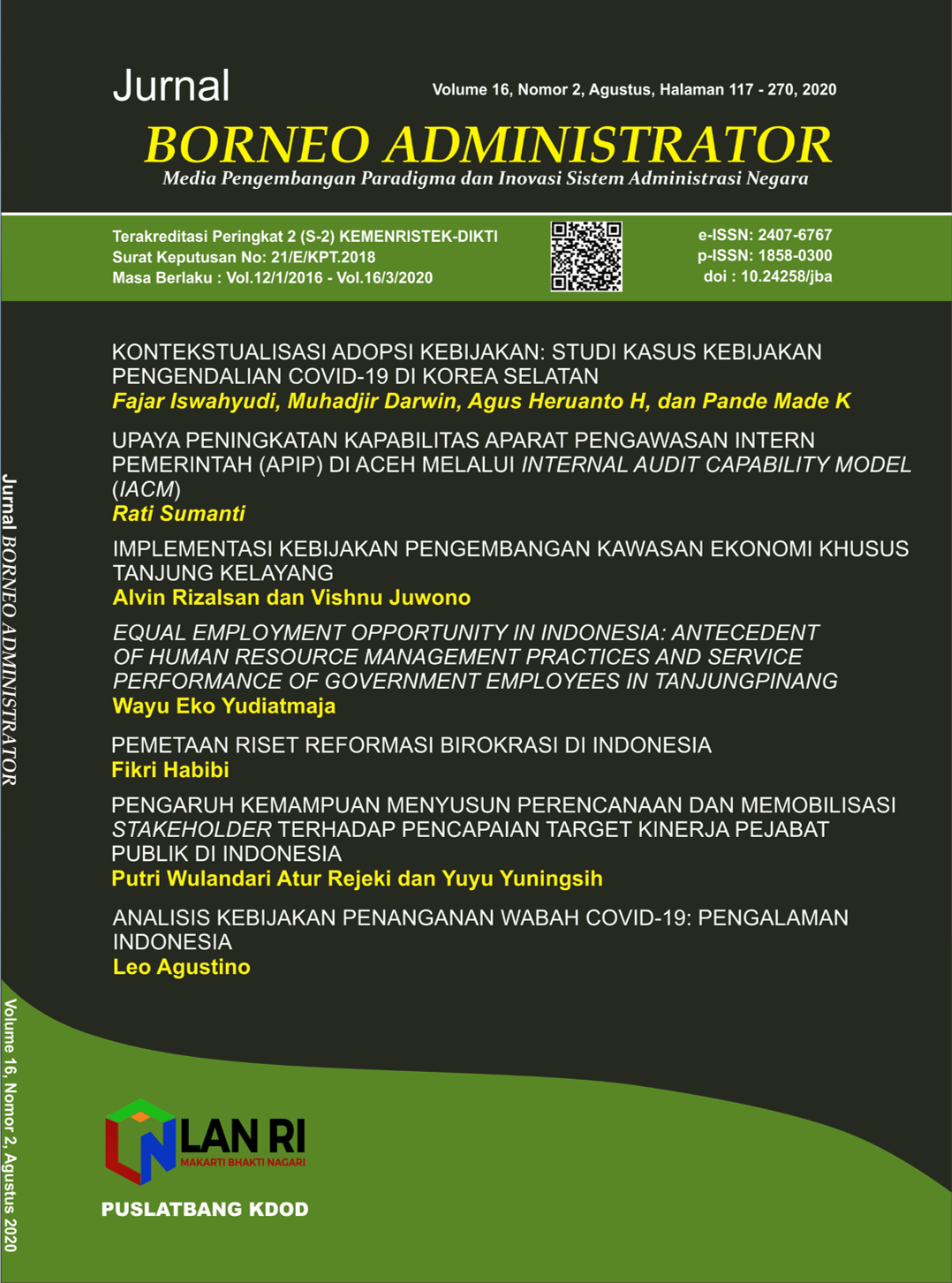
Analisis Kebijakan Penanganan Wabah Covid-19: Pengalaman Indonesia
Analysis of Covid-19 Outbreak Handling Policy: The Experience of Indonesia
DOI:
https://doi.org/10.24258/jba.v16i2.685Abstract
This article discusses the efforts of the Indonesian Government in handling the outbreak of Corona Virus Disease-19 (COVID-19). The handling strategies assessed by understanding the efforts, steps, and policies formulated and implemented by the government while the analysis used a deliberative policy analysis approach was used. This approach analyzes the narratives and arguments of the authorities to understand the decision making and policy implementation. The research used a qualitative approach by utilizing descriptive analysis methods. Then the data collection technique used literature studies. The findings found that, first, negative narratives and the slow response of the government. Before COVID-19 approached Indonesia, narratives delivered by the elite government showed that there was no sense of crisis so that it slow-down decision making. Second, weak coordination, especially between the central government and regional governments. This asynchronous coordination created uncertain handling for the control of Coronavirus. Third, citizen ignorance or disobey government instruction. The impact is, the handling effort has stalled because it is not supported by the wider community. The combination of these three factors complicates the government's efforts to control the outbreak of COVID-19 in Indonesia.
Keywords: Indonesia, COVID-19, Coronavirus, Handling, Policy
Abstrak
Artikel ini mendiskusikan mengenai upaya Pemerintah Indonesia dalam menangani kasus penyebaran virus korona (Corona Virus Disease-19 (COVID-19). Dengan memahami upaya, langkah, dan kebijakan yang diformulasi dan diimplementasikan oleh pemerintah maka dapat dinilai strategi penanganan tersebut. Untuk menganalisis kasus ini, pendekatan deliberative policy analysis digunakan. Pendekatan ini menganalisis narasi dan argumentasi pihak berwenang untuk memahami pembuatan keputusan dan pelaksanaan kebijakan. Penulisan artikel ini menggunakan pendekatan kualitatif dengan memanfaatkan metode deskriptif analisis. Sementara itu, teknik pengumpulan data yang digunakan adalah studi kepustakaan yang memanfaatkan buku, artikel jurnal, surat kabar, berita online, serta website lembaga-lembaga otoritatif. Temuan penting dari tulisan ini adalah, pertama, narasi negatif dan lambannya respons pemerintah atas penyebaran COVID-19. Narasi-narasi yang disampaikan oleh elite politik sebelum COVID-19 masuk ke Indonesia menunjukkan nihilnya perasaan adanya krisis (sense of crisis) yang mengancam sehingga memperlambat pengambilan keputusan. Kedua, lemahnya koordinasi antar-stakeholder, khususnya antara pemerintah pusat dan pemerintah daerah. Ketidaksinkronan koordinasi ini mengakibatkan pengendalian virus korona menjadi terkatung-katung. Ketiga, ketidakacuhan atau ketidakpatuhan warga atas himbauan pemerintah. Impaknya, upaya penanganan menjadi tersendat karena tidak didukung oleh masyarakat luas. Kombinasi dari ketiga faktor inilah yang memperumit upaya pemerintah untuk mengendalikan penyebaran COVID-19 di Indonesia.
Kata Kunci: Indonesia, COVID-19, Virus Korona, Penanganan, Kebijakan
Downloads
Downloads
Published
How to Cite
Issue
Section
License
Copyright (c) 2020 Author(s)

This work is licensed under a Creative Commons Attribution-NonCommercial-ShareAlike 4.0 International License.
Policy for Journals That Offer Open Access
Authors who publish with this journal agree to the following terms:
- Authors retain copyright and grant the journal right of first publication with the work simultaneously licensed under a Creative Commons Attribution-NonCommercial-ShareAlike 4.0 International License that allows others to share the work with an acknowledgement of the work's authorship and initial publication in this journal.
- Authors are able to enter into separate, additional contractual arrangements for the non-exclusive distribution of the journal's published version of the work (e.g., post it to an institutional repository or publish it in a book), with an acknowledgement of its initial publication in this journal.
- Authors are permitted and encouraged to post their work online (e.g., in institutional repositories or on their website) prior to and during the submission process, as it can lead to productive exchanges, as well as earlier and greater citation of published work (See The Effect of Open Access).