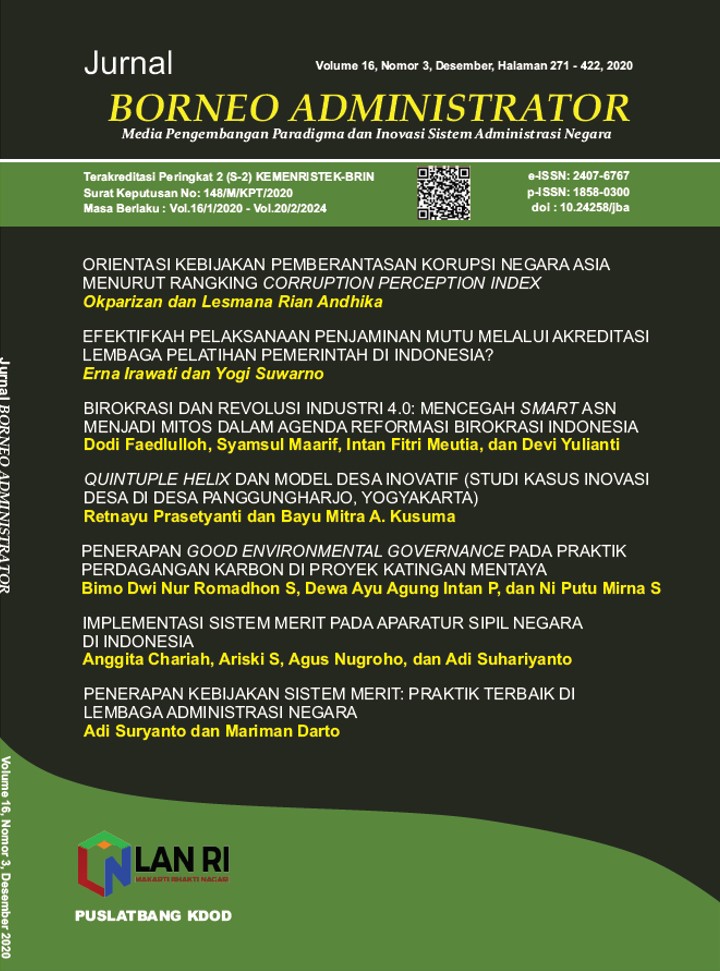
Penerapan Good Environmental Governance pada Praktik Perdagangan Karbon di Proyek Katingan Mentaya
The Implementation of Good Environmental Governance in Carbon Trading Practices at Katingan Mentaya Project
DOI:
https://doi.org/10.24258/jba.v16i3.693Abstract
The implementation of good governance by continuing to prioritize respect for the environment (good environmental governance) is very suitable to be applied during the environmental problems that occur recently. The implementation of good environmental governance in carbon trading practices in the Katingan Mentaya Project ishe collaboration between the government, private sector, and community, which becomes the main focus of this research. The division of power, duties and authority among the stakeholders is analyzed with 3 principles of good environmental governance. This study revealed an academic study related to “the increasing degree of power-sharing between state and market actorsâ€, where the division of roles between the government and market actors in stage of expanding towards an ideal position. The government (KLHK) is still developing its role as a regulator, while market actor (PT. RMU) is still exploring its potential efforts based on the midst of environmental and community empowerment at Katingan Mentaya Project’s area. The existed of a statue or legal product that contains carbon trading mechanisms based on the principle of non-overlapping good environmental governance is very necessary for alleviating problems and obstacles that arise.
Keywords: Good Environmental Governance, Carbon Trading, Katingan Mentaya Project
Abstrak
Penyelenggaraan pemerintahan yang baik dengan tetap mengedepankan penghormatan terhadap lingkungan (good environmental governance) sangat sesuai untuk diterapkan di tengah permasalahan lingkungan yang kerap terjadi belakangan ini. Penerapan good environmental governance dalam praktik perdagangan karbon di Proyek Katingan Mentaya, yang merupakan kolaborasi antara pemerintah, swasta, dan masyarakat menjadi fokus utama dalam penelitian ini. Pembagian kekuasaan, tugas, dan wewenang di antara para pelaksana yang terlibat dianalisis dengan tiga prinsip good environmental governance. Penelitian ini mengungkapkan kajian akademik terkait “the increasing degree of power sharing between state and market actorsâ€, yaitu pembagian peran antara pemerintah dan pelaku pasar dalam tahap berkembang (expanding) menuju posisi ideal. Pemerintah (KLHK) masih terus berkembang dalam perannya sebagai regulator dalam menciptakan kebijakan, sedangkan pihak swasta (PT. RMU) masih dalam tahap menggali potensi dengan tetap memperhatikan usaha yang berbasis lingkungan dan upaya pemberdayaan masyarakat di area Proyek Katingan Mentaya. Kehadiran suatu statue atau produk hukum yang memuat tentang mekanisme perdagangan karbon berdasarkan prinsip good environmental governance yang tidak tumpang tindih tentu saja sangat diperlukan, dalam mengentaskan permasalahan dan penghambat yang timbul.
Kata Kunci: Good Environmental Governance, Perdagangan Karbon, Proyek Katingan Mentaya
Downloads
Downloads
Published
How to Cite
Issue
Section
License
Copyright (c) 2020 Author(s)

This work is licensed under a Creative Commons Attribution-NonCommercial-ShareAlike 4.0 International License.
Policy for Journals That Offer Open Access
Authors who publish with this journal agree to the following terms:
- Authors retain copyright and grant the journal right of first publication with the work simultaneously licensed under a Creative Commons Attribution-NonCommercial-ShareAlike 4.0 International License that allows others to share the work with an acknowledgement of the work's authorship and initial publication in this journal.
- Authors are able to enter into separate, additional contractual arrangements for the non-exclusive distribution of the journal's published version of the work (e.g., post it to an institutional repository or publish it in a book), with an acknowledgement of its initial publication in this journal.
- Authors are permitted and encouraged to post their work online (e.g., in institutional repositories or on their website) prior to and during the submission process, as it can lead to productive exchanges, as well as earlier and greater citation of published work (See The Effect of Open Access).