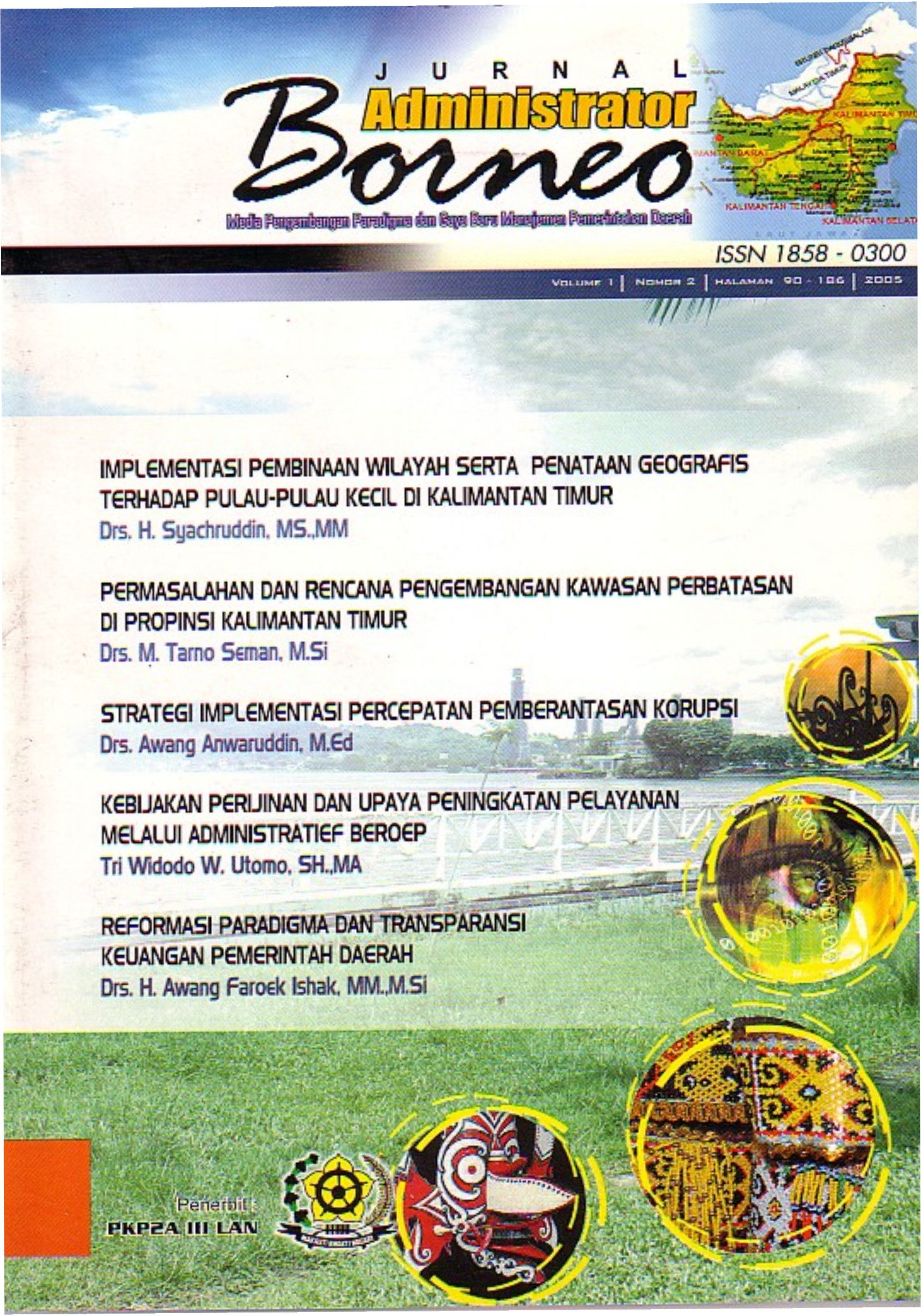
REFORMASI PARADIGMA DAN TRANSPARANSI KEUANGAN PEMERINTAH DAERAH
DOI:
https://doi.org/10.24258/jba.v1i2.8Abstract
During New Order epoch, Indonesia’s governmental system was very centralized. Consequently, local governments’ dependency on central government budget and policies is remarkably apparent. The genesis of 1999 extended-decentralization framework aims not only to reduce the fiscal dependency, but also to alter the development paradigm from growth-oriented to distribution and equity-oriented strategies. In other words, the purpose of regional autonomy is actually to strengthen the economic basis of local development. In order to attain such idea, this paper highlights the importance to reform the existing budgeting system and cycles.Downloads
Download data is not yet available.
Downloads
Published
2014-01-22
How to Cite
Faroek Ishak, D. H. A. (2014). REFORMASI PARADIGMA DAN TRANSPARANSI KEUANGAN PEMERINTAH DAERAH. Jurnal Borneo Administrator, 1(2). https://doi.org/10.24258/jba.v1i2.8
Issue
Section
Articles
License
Copyright (c) 2014 Author(s)

This work is licensed under a Creative Commons Attribution-NonCommercial-ShareAlike 4.0 International License.
Policy for Journals That Offer Open Access
Authors who publish with this journal agree to the following terms:
- Authors retain copyright and grant the journal right of first publication with the work simultaneously licensed under a Creative Commons Attribution-NonCommercial-ShareAlike 4.0 International License that allows others to share the work with an acknowledgement of the work's authorship and initial publication in this journal.
- Authors are able to enter into separate, additional contractual arrangements for the non-exclusive distribution of the journal's published version of the work (e.g., post it to an institutional repository or publish it in a book), with an acknowledgement of its initial publication in this journal.
- Authors are permitted and encouraged to post their work online (e.g., in institutional repositories or on their website) prior to and during the submission process, as it can lead to productive exchanges, as well as earlier and greater citation of published work (See The Effect of Open Access).