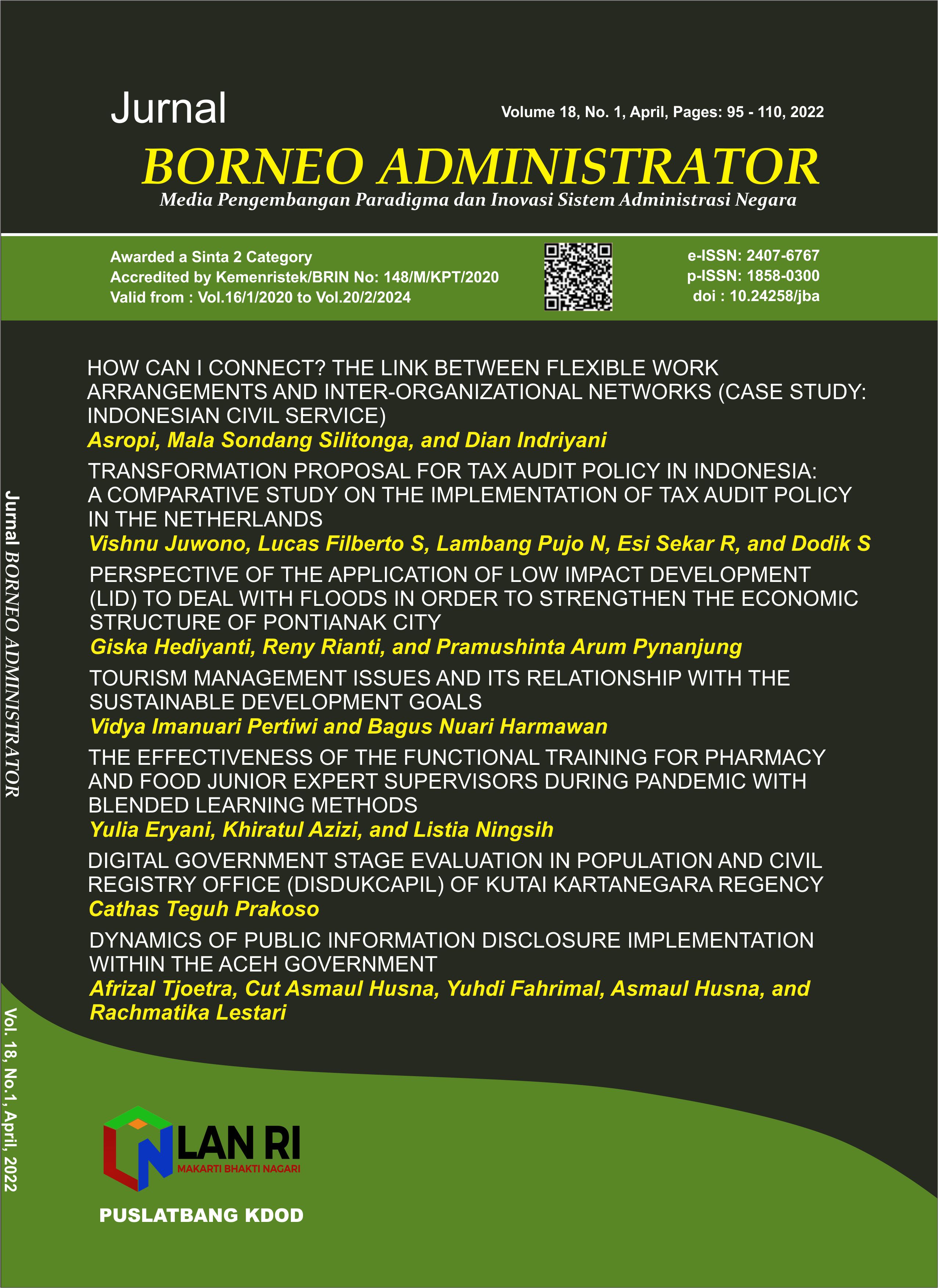
Transformation Proposal for Tax Audit Policy in Indonesia: A Comparative Study on the Implementation of Tax Audit Policy in the Netherlands
DOI:
https://doi.org/10.24258/jba.v18i1.886Abstract
A tax audit policy is intended to increase taxpayer compliance and trust towards tax authority. In Indonesia, the low level of trust carried out by tax audits observed from the taxpayer compliance level shows the shortcoming of implementing the tax audit system. Based on this phenomenon, this study is conducted to describe problems regarding the implementation of tax audit policy in Indonesia and provide recommendations for the Indonesian tax authority to transform tax audit policy practised by the tax audit system in the Netherlands. The Netherlands was selected as the research site, for this country is one of the OECD pioneers and has been part of AEoI. This study applied a qualitative approach. An in-depth interview was used to collect the data from competent parties in tax audits, both in Indonesia and the Netherlands. The findings showed that two factors caused the shortcoming of the tax audit system in Indonesia. First, the database was not maximal due to nonoptimal digitalisation and data integration. Second, the selection system for taxpayers to be audited was closed. Therefore, this study recommends that tax authorities in Indonesia develop an accountable and reliable tax audit system as implemented by tax authorities in the Netherlands. Tax audit optimisation can be done by increasing the database through digitalisation and data integration to facilitate information exchange. After implementing policy transformation, it is expected that taxpayer compliance and tax legitimacy will also increase
Downloads
Downloads
Published
How to Cite
Issue
Section
License
Copyright (c) 2022 Author(s)

This work is licensed under a Creative Commons Attribution-NonCommercial-ShareAlike 4.0 International License.
Policy for Journals That Offer Open Access
Authors who publish with this journal agree to the following terms:
- Authors retain copyright and grant the journal right of first publication with the work simultaneously licensed under a Creative Commons Attribution-NonCommercial-ShareAlike 4.0 International License that allows others to share the work with an acknowledgement of the work's authorship and initial publication in this journal.
- Authors are able to enter into separate, additional contractual arrangements for the non-exclusive distribution of the journal's published version of the work (e.g., post it to an institutional repository or publish it in a book), with an acknowledgement of its initial publication in this journal.
- Authors are permitted and encouraged to post their work online (e.g., in institutional repositories or on their website) prior to and during the submission process, as it can lead to productive exchanges, as well as earlier and greater citation of published work (See The Effect of Open Access).