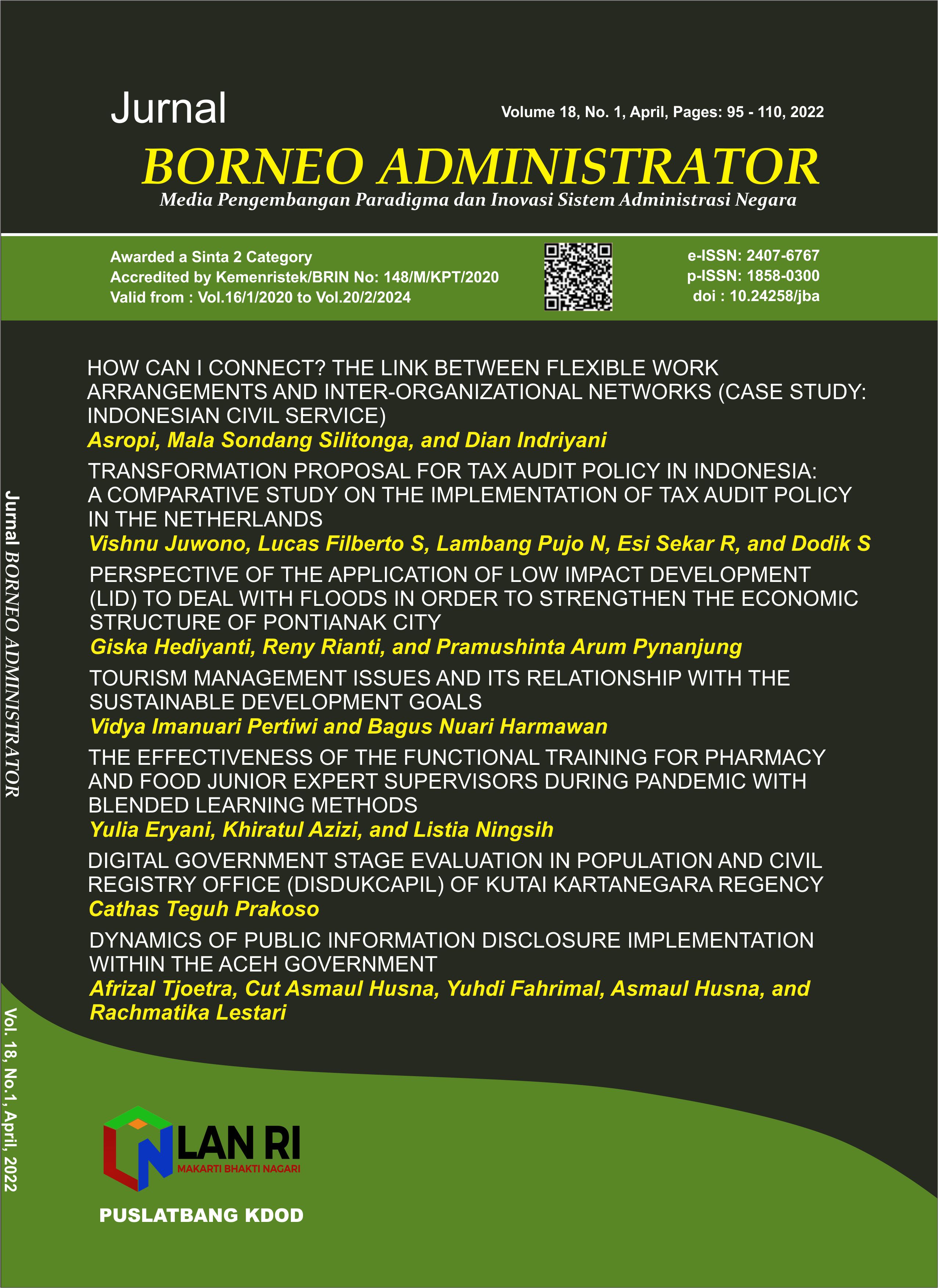
Perspective of the Application of Low Impact Development (LID) to Deal with Floods to Strengthen the Economic Structure of Pontianak City
DOI:
https://doi.org/10.24258/jba.v18i1.909Abstract
Pontianak city is the capital of West Kalimantan Province, undergoing dynamic growth and development in various sectors. However, it is often hit by inundation or flooding, affecting region development, particularly economic structure. The effort that can be made is the Low Impact Development (LID) Approach to overcome flooding and inundation in urban areas while providing economic value benefits. This research analyzed the economic structure of Pontianak City with an analysis of LQ, Typology Klassen and Shifted Share to look at the growth of the base sector and the movement of economic structures. AHP analysis is used to look at the perspective of LID application in Pontianak City. The results showed that the water procurement, waste management, by products, and recycling sectors became one of the base sectors in Pontianak City. However, the results of shift-share analysis on the competitive advantage component (Cij) showed the sector was moving more slowly than the Provincial level. Policies are needed to accelerate the growth of the water management sector, one of which is a policy to overcome the problem of flooding and inundation in Pontianak city and concomitantly strengthen its economic structure. The results of the AHP analysis showed the selected form of LID application, namely water tanks, rain gardens, bioretention, filter strips, infiltration trenches, porous pavement, and infiltration wells that lead to small-scale or self-contained applications. Sensitivity analysis shows that the criteria for land needs are very sensitive and most affect other measures, namely cost, in determining LID application. Therefore, the commitment of the Pontianak City Government as a regulator, dynamic actor, and facilitator is needed to support policies and budgets that strengthen the economic structure of Pontianak City as well as a cross-sectoral working atmosphere and healthy investment to support the implementation of LID
Downloads
Downloads
Published
How to Cite
Issue
Section
License
Copyright (c) 2022 Author(s)

This work is licensed under a Creative Commons Attribution-NonCommercial-ShareAlike 4.0 International License.
Policy for Journals That Offer Open Access
Authors who publish with this journal agree to the following terms:
- Authors retain copyright and grant the journal right of first publication with the work simultaneously licensed under a Creative Commons Attribution-NonCommercial-ShareAlike 4.0 International License that allows others to share the work with an acknowledgement of the work's authorship and initial publication in this journal.
- Authors are able to enter into separate, additional contractual arrangements for the non-exclusive distribution of the journal's published version of the work (e.g., post it to an institutional repository or publish it in a book), with an acknowledgement of its initial publication in this journal.
- Authors are permitted and encouraged to post their work online (e.g., in institutional repositories or on their website) prior to and during the submission process, as it can lead to productive exchanges, as well as earlier and greater citation of published work (See The Effect of Open Access).