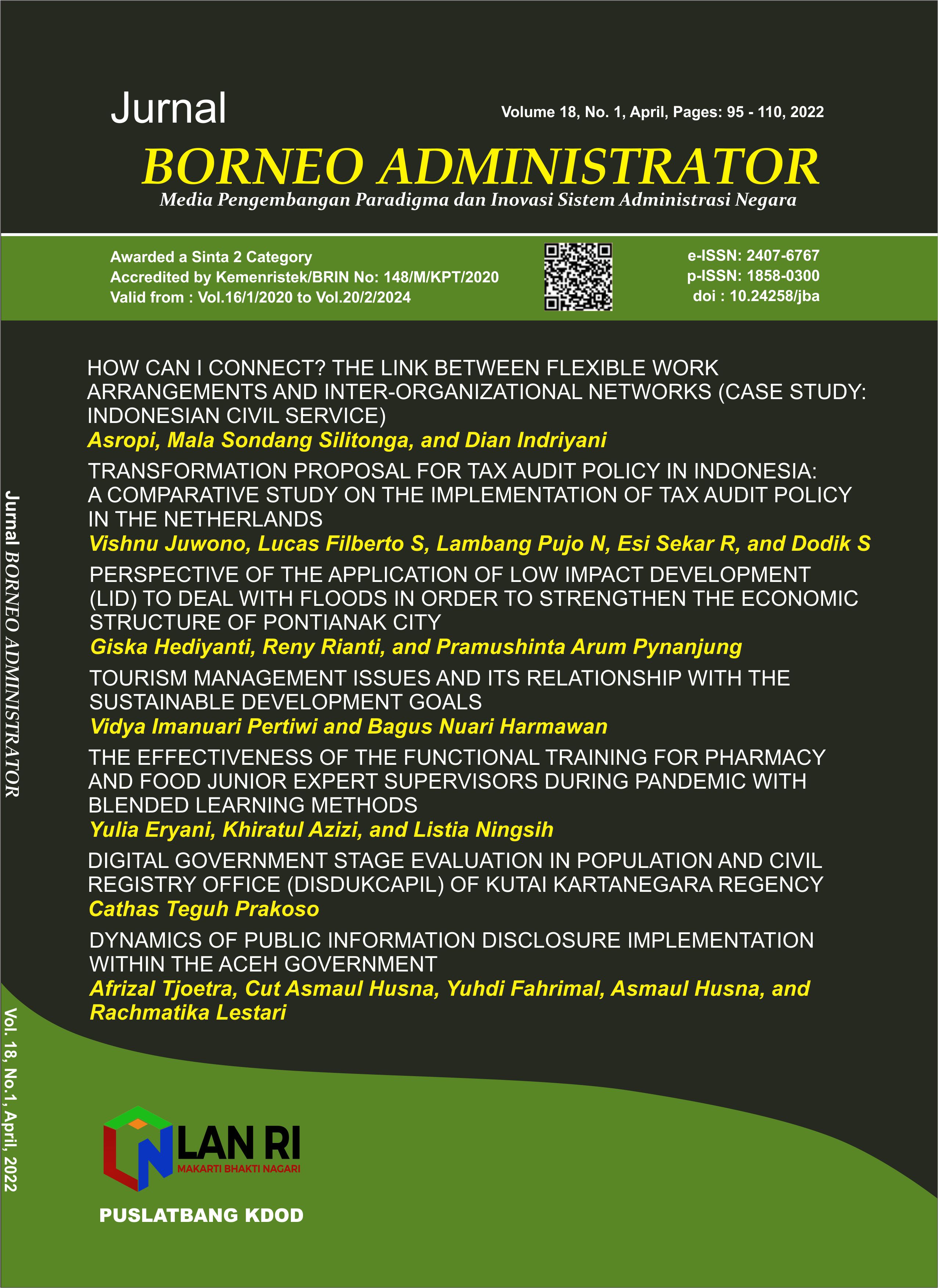
Dynamics of Public Information Disclosure Implementation within the Aceh Government
DOI:
https://doi.org/10.24258/jba.v18i1.954Abstract
Post-armed conflict and tsunami disasters, the Government of Aceh seek to implement public services and development programs transparent and accountable. One of the strategic steps taken is its implementation based on the mandate of the public information disclosure Act (KIP Law) and Aceh Qanun (Aceh Regional Regulation) Number 7 of 2019 on KIP Management. Even though it already has KIP rules, there are still some problems in its implementation, such as compliance with SKPA in providing public information and the number of disputes over public information. This study aims to identify and analyze the dynamics of the implementation of public information within the Aceh Government and the challenges of public management. This study uses a qualitative method through observation, document review, and interviews. The basis of data analysis uses Information Commission Regulation Number 1 of 2010 and Aceh Governor Regulation Number 57 of 2018. The results are (1) SKPA has work plans, programs, and activities for the management of public information; (2) there is a budget allocation for Information and Documentation Implementation Officers (PPID); (3) It has a list of public information and SOPs. The findings of this study also find logistical consequences for the future of Aceh's development through the KIP perspective. Information that is open, accessible, and inexpensive can nurture public trust in the Aceh Government and in itself will increase community participation in development. Trust is the principal social capital in the development of community welfare
Downloads
Downloads
Published
How to Cite
Issue
Section
License
Copyright (c) 2022 Author(s)

This work is licensed under a Creative Commons Attribution-NonCommercial-ShareAlike 4.0 International License.
Policy for Journals That Offer Open Access
Authors who publish with this journal agree to the following terms:
- Authors retain copyright and grant the journal right of first publication with the work simultaneously licensed under a Creative Commons Attribution-NonCommercial-ShareAlike 4.0 International License that allows others to share the work with an acknowledgement of the work's authorship and initial publication in this journal.
- Authors are able to enter into separate, additional contractual arrangements for the non-exclusive distribution of the journal's published version of the work (e.g., post it to an institutional repository or publish it in a book), with an acknowledgement of its initial publication in this journal.
- Authors are permitted and encouraged to post their work online (e.g., in institutional repositories or on their website) prior to and during the submission process, as it can lead to productive exchanges, as well as earlier and greater citation of published work (See The Effect of Open Access).