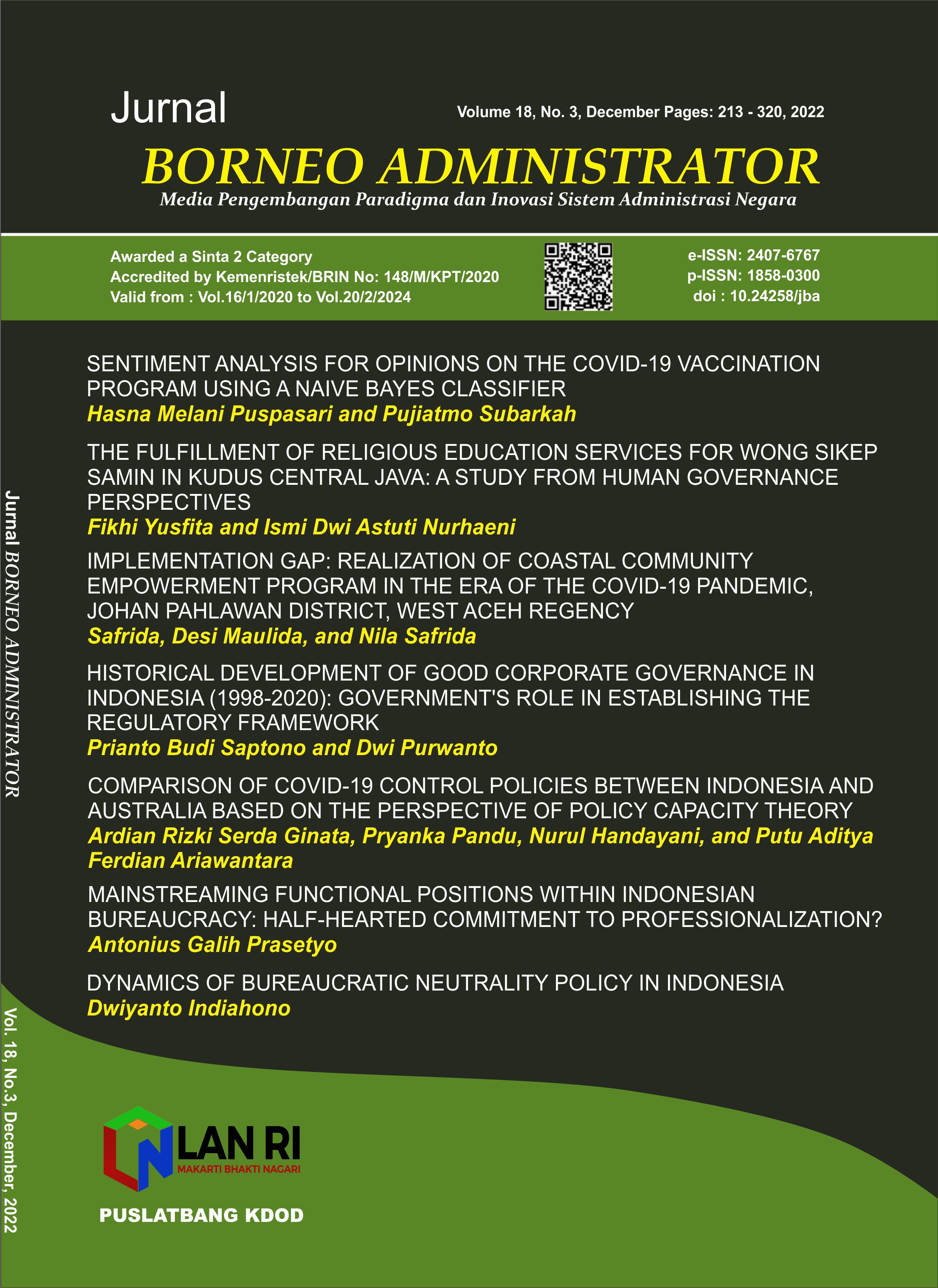
Implementation Gap: Realization of Coastal Community Empowerment Program in the Era of the Covid-19 Pandemic, Johan Pahlawan District, West Aceh Regency
DOI:
https://doi.org/10.24258/jba.v18i3.985Abstract
The Covid-19 pandemic has caused chaos in the living order of the world community, including Indonesia. As a maritime country with a high population in coastal areas, the pandemic has caused the economic stability of fishermen to decrease drastically, so solutions are needed in the form of empowerment programs not to cause greater problems. This study aims to find the implementation of the coastal community empowerment program carried out by the government in the era of the Covid-19 pandemic, Johan Pahlawan District, West Aceh Regency, which is the centre of fisheries and marine management locations in the Regency. The research method that the author uses is descriptive qualitative. The results found through this research are that the government's empowerment during the pandemic is mostly only in the form of financial assistance. They even realize the aid funds provided to fishermen groups are still not on target. Therefore, this study concludes that implementing the coastal community empowerment program by the government remains inappropriate and unsuccessful in overcoming the problems faced by fishermen back from the past to the current Covid-19 pandemic. Thus, the government must prioritize the community's needs by improving the management of fishermen's businesses, such as forming cooperatives and increasing cooperation with partners, which are the main aspects of improvement to improve the fishermen's standard of living
Downloads
Downloads
Published
How to Cite
Issue
Section
License
Copyright (c) 2022 Author(s)

This work is licensed under a Creative Commons Attribution-NonCommercial-ShareAlike 4.0 International License.
Policy for Journals That Offer Open Access
Authors who publish with this journal agree to the following terms:
- Authors retain copyright and grant the journal right of first publication with the work simultaneously licensed under a Creative Commons Attribution-NonCommercial-ShareAlike 4.0 International License that allows others to share the work with an acknowledgement of the work's authorship and initial publication in this journal.
- Authors are able to enter into separate, additional contractual arrangements for the non-exclusive distribution of the journal's published version of the work (e.g., post it to an institutional repository or publish it in a book), with an acknowledgement of its initial publication in this journal.
- Authors are permitted and encouraged to post their work online (e.g., in institutional repositories or on their website) prior to and during the submission process, as it can lead to productive exchanges, as well as earlier and greater citation of published work (See The Effect of Open Access).