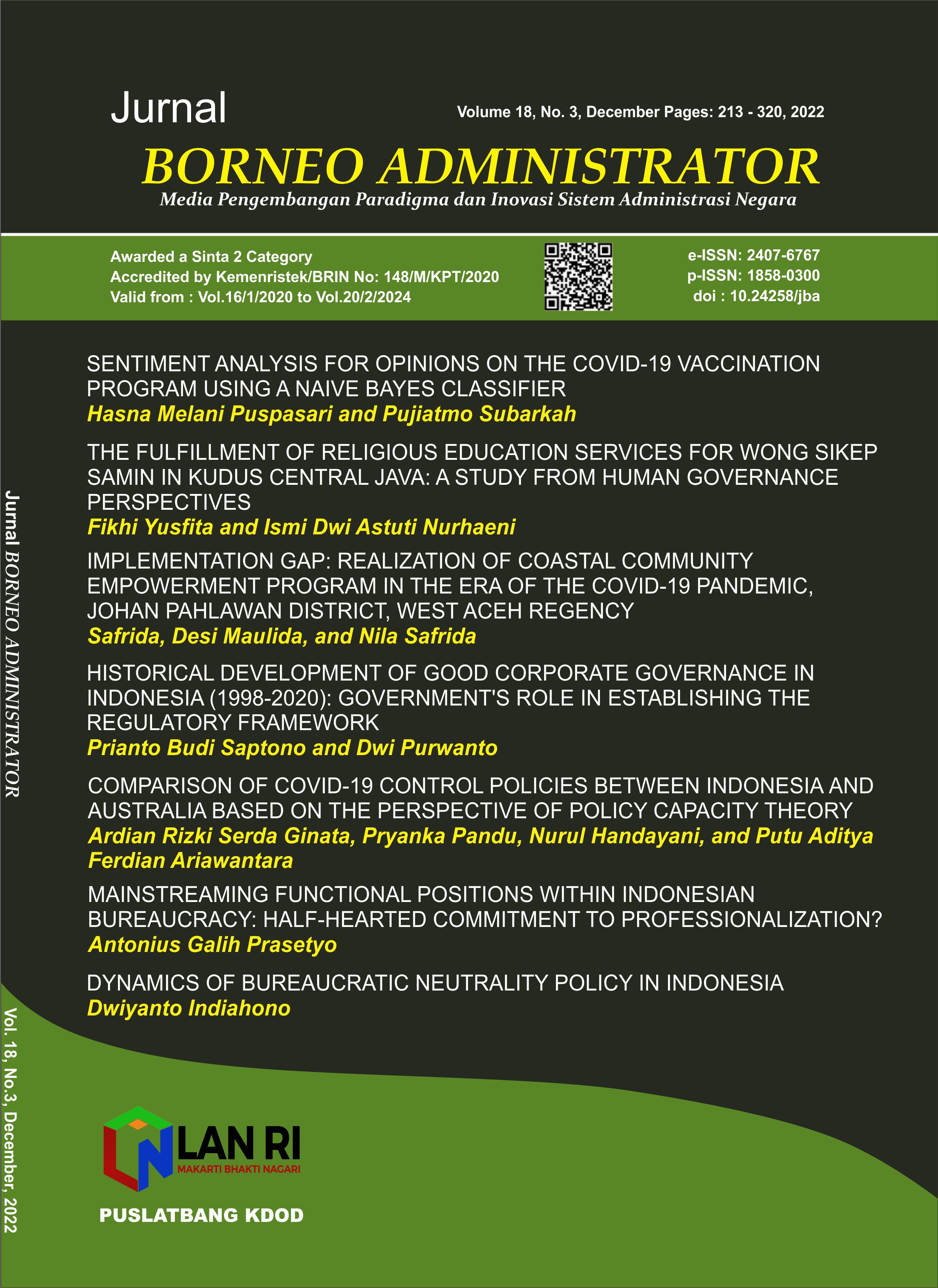
Sentiment Analysis for Opinions on the Covid-19 Vaccination Program Using a Naive Bayes Classifier
DOI:
https://doi.org/10.24258/jba.v18i3.992Abstract
Implementing the COVID-19 vaccination program was not easy because it received various responses from the public. This study will explore public sentiment on the program which was taken based on public comments on several videos on YouTube using data crawling techniques using Coberry tools. The data was public opinions in Bahasa Indonesia that will be collected based on videos from official news channels with high engagement in the last eight months. Sentiment analysis was carried out using the Naive Bayes Classifier method that can be used to make deep analysis through filtering and classifying the opinions of the Indonesian people, as stated on YouTube. This research showed that public sentiment was dominated by negative sentiment based on some public doubts regarding the side effects of vaccines and the government follow-up regarding the country's economic recovery. Compared with the previous studies, the conclusions of sentiment obtained by this study were not the same due to differences in data sources and the selection of timeframes for community responses. An analysis of the public responses that have been carried out using a data collection method like this one will be very effective in providing an overview of the public desire to facilitate policymakers in formulating policy designs for the public interest
Downloads
Downloads
Published
How to Cite
Issue
Section
License
Copyright (c) 2022 Author(s)

This work is licensed under a Creative Commons Attribution-NonCommercial-ShareAlike 4.0 International License.
Policy for Journals That Offer Open Access
Authors who publish with this journal agree to the following terms:
- Authors retain copyright and grant the journal right of first publication with the work simultaneously licensed under a Creative Commons Attribution-NonCommercial-ShareAlike 4.0 International License that allows others to share the work with an acknowledgement of the work's authorship and initial publication in this journal.
- Authors are able to enter into separate, additional contractual arrangements for the non-exclusive distribution of the journal's published version of the work (e.g., post it to an institutional repository or publish it in a book), with an acknowledgement of its initial publication in this journal.
- Authors are permitted and encouraged to post their work online (e.g., in institutional repositories or on their website) prior to and during the submission process, as it can lead to productive exchanges, as well as earlier and greater citation of published work (See The Effect of Open Access).